
NIFS was thrilled to begin fitness management services at two new retirement community client sites in April. Furthermore, we were honored to be able to tailor our staffing services for the unique needs of each location. Community fitness and wellness programs can’t be addressed with a cookie-cutter approach. Read on to learn how NIFS is supporting the unique needs of each location and their residents.
Peabody: 20-Hour-per-Week Fitness Manager
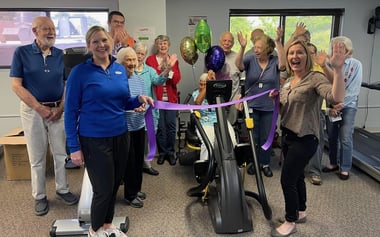
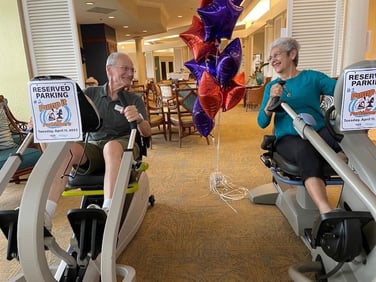
Peabody is a CCRC in North Manchester, Indiana. Although Peabody did not have a fitness center for its residents until the grand opening of the brand new Billie Jean Strauss Wellness Center in April, NIFS has been supporting this community since early 2012 through consulting and equipment recommendations. NIFS provided recommendations for the fitness center and aerobics studio, including everything from treadmills to strength equipment to balance-training tools and space layouts. When the build was complete, NIFS was able to support the equipment installation and helped the community prepare for the grand opening celebration.
Because Peabody residents are not accustomed to exercising in an onsite fitness center or having group fitness class options in an aerobics studio, the community began staffing services at 20 hours per week with a NIFS Fitness Manager. As NIFS’s best-in-class fitness programming sparks resident engagement and enthusiasm, they anticipate growing the manager position to full-time to add more opportunities and services for residents. So far the launch of the program has been a great success and residents have been very eager to learn about the new equipment and program. NIFS is excited to expand the possibilities for Peabody residents and grow with the community.
Sandhill Cove: 40 Hour-per-Week Wellness Director
Sandhill Cove is a CCRC in Palm City, Florida. The community has a fitness center, pool, and contracted group fitness and personal training services. NIFS visited the community for a consulting arrangement in the fall of 2012 and provided a variety of recommendations to unify their program offerings in creating a stronger wellness brand. Following those recommendations, community leadership felt that NIFS could best lead this movement for the community and began staffing services with a full-time NIFS Waterfront Wellness Director.
The community had strong elements of a wellness program in place for its residents. The Wellness Director will be leading the initiative at the community and helping to pull in the various programs, services, and personnel under a unified vision for the program. In addition, the Wellness Director will be providing NIFS’s traditional best-in-class fitness programming and management services.
NIFS launched at the community in early April and we are thrilled with the progress made with increasing resident awareness of new and existing services available at the community and with the turnout at the Waterfront Wellness Open House. Residents received a passport to guide them on a tour of different booths. The booths highlighted different programs and service offerings around the community and educated participants on the different dimensions of wellness. Eighty-nine percent of residents who participated in the event submitted a completed passport indicating that they visited every booth. This was a great first step in helping residents identify the various programs and service offerings available at Sandhill Cove under the Waterfront Wellness Program.
We sit. Frankly, we sit a lot. We sit at home, we sit on our commutes, we sit at work, we sit during our child’s after-school activities. Sit, sit, sit. And it’s not doing us any favors, either. In fact, recent startling statistics indicate that sitting may be a significant threat to our overall wellbeing.
Before you write this off as one of those “it can’t be that bad” indicators, consider these statistics. There are even more (if you need more convincing) in this compelling infographic.
- Sitting six hours a day increases your risk of death by 40% over someone who sits less than three hours.
- Between 1980 and 2000, exercise rates remained the same, but sitting time increased 8% and obesity doubled.
- People with sitting jobs have twice the rate of cardiovascular disease as people who stand for work.
And to those of you who say that sitting disease is really a problem only for people who don’t work out, think again. Data shows that prolonged sitting can negate some of the benefits you receive from regular exercise. Let me just say it one more time: How often we sit is a problem.
NIFS’s Fit-It-In Gets Results in Combating Sitting
So there it is: sitting is our great nemesis. If you’ve been wracking your brain for strategies that actually combat the gravitational pull to a chair, look no further. Below is an outline for one of NIFS’s award-winning programs, Fit-It-In, with real results that can be implemented in any worksite health setting.
But before I get into program specifics, I need to say that if you don’t have built-in strategies for evaluating your programs, you’ll want to be sure you establish that basic infrastructure in order to determine whether your efforts at combating sitting disease are actually working. For more on how NIFS evaluates our programs, read this blog. After all, without effective evaluation strategies, you can’t get fantastic data like this: Before Fit-It-In started, 100% of associates polled indicated they were sedentary at least four hours per day. By the end of the program, only 8% of associates polled indicated that they were sedentary four or more hours per day.
In the Beginning
This conceptually simple and highly effective program, called Fit-It-In, is the brainchild of one of NIFS’s managers, Kathy Douglas. Kathy manages a corporate fitness center for NIFS at a client where there is a lot of sitting. She, like most of us in worksite health promotion, had been following the news coming out in the last few years about the dangers of sitting and felt compelled to address this for the associates she serves.
She knew that if she could just get them into the fitness center, she could help them, even with small breaks in the day, to feel better and to gradually improve their health. But she was up against (1) individual inertia, and (2) a corporate culture for productivity that kept associates in their seats.
After much research, discussion with leadership at her client location, and careful outlining of the program’s goals and objectives, she launched Fit-It-In. The primary goal of the program was to help improve associate health and engagement by providing them with an efficient and convenient method of fitting in more physical activity throughout their workday.
Fighting Inertia to Improve Employee Health
Kathy knew she had a lot of work to do to reach the 500+ associates at her location with a message about moving more, and she was certain that focusing on getting them into the fitness center was going to be met with significant resistance. So she brought exercise to the associates and incorporated a variety of simple opportunities/events through which associates could engage in movement-oriented activities without having to truly work out.
Program features included the following:
- Fitness bands to all associates
- Online workout and stretching documents
- Indoor and outdoor walking routes
- Motivational stairwell challenges
- Fitness band exercise challenge of the month
- “15-2-Fit” 15-minute workout cards available in the fitness center
- 5-Minute Flash Mob fitness band exercise events
- “YES You Can―Fit-It-In” informational kiosk
- Monthly grand-prize drawing
Pretty great list of services in the initiative, right? Well, here’s the thing: Kathy knew (she’s been with this client for five years) that unless she was able to get support from mid-level managers, this initiative would flop, no matter how creative, relevant, simple, or potentially impactful it was.
Engaging Managers to Support Employee Exercise
Truly, this is what sets this program apart from others. Kathy spent a significant amount of front-end time with managers in the organization talking with them about Fit-It-In: how it would benefit their productivity goals as well as the health of their department members. She also sought buy-in from the executive leadership in her location so that the mid-level managers would know they had the support they needed to get Fit-It-In off the ground in their division.
Easy enough. On to the next steps, right? Unfortunately, it took a lot of effort on Kathy’s part to overcome managers’ resistance to allowing their employees to move for five minutes during a meeting, or at each hourly bell. There were significant concerns in some areas about productivity and department goals being compromised because employees would not be 100% focused on work 100% of the time.
It’s a common hurdle, but it’s not commonly overcome. Kathy was able to gain a lot of traction with these supervisors by presenting Fit-It-In jointly with Human Resources. She engaged the managers in conversation at the end of the presentation to listen to their concerns and other feedback. Kathy added elements to the initiative in response to those discussions and ultimately was able to remove most of the identified barriers to generate a win-win message.
If you want to read about how Kathy was able to go from 100% of associates reporting that they were sedentary for four or more hours to just 8% indicating that they were sedentary for four or more hours each day, you won’t want to miss part 2 of this blog. We’ll dig into the data, as well as offer an overview on how the program was implemented. I’ll also outline some of our key lessons learned.
If you quietly answered yes to that question and then pulled your office door shut so no one would know you were reading this blog, it’s okay. Take a deep breath. You’re not the only one who has struggled with occupancy at one time or another.
Kudos to you for looking at alternative means to boost your occupancy. It’s true: wellness programming hasn’t been a traditional area for tackling occupancy issues. But as more and more communities get on board with providing a healthy lifestyle for their residents, a creative and well-executed resident wellness strategy will become essential for communities to compete in the marketplace.
That may be the future, but I don’t think it’s too far off. And positioning your community now with a standout fitness and wellness program for your residents will only build your competitive advantage.
If you’re looking for some baby steps to take to get you started, consider reviewing the National Whole-Person Wellness Survey available from Mather LifeWays for $15. The report is extensive and details various trends in community wellness, covering multiple dimensions as well as details about program participation and anticipated future trends in community wellness.
You can also register for the NIFS Build Vitality webinar series. In this free four-part webinar series, we cover wellness branding, fitness centers, wellness staffing, and wellness programs.
If this all seems like too much to bite off for now, watch the short video below to hear why senior living marketing professionals are convinced robust wellness programming is central to their occupancy success.

Do you like what you see? NIFS Monthly Bulletin Boards are available for purchase to utilize in your corporate fitness center or active aging community,
contact us for more information.
Part 2: Your Program Is Set Up... Now What?
In the first part of this blog, we talked about key strategies to set your program up for success. Remember “begin at the beginning” and “map out the ‘how’”? If you’re still intent on getting data you can actually use from your wellness program, keep reading to learn what do to now that you’re ready to run the initiative.
#3: Stick to the Plan
This seems so obvious, so I won’t spend much time on it. Here’s the thing: you spend a lot of time mapping out the goals and the objectives to achieve those goals, and then you design your program around that outline. For heaven’s sake, stick to the plan. Implement the program as close to the original design as possible. If you get into the offering and you find a fatal flaw in the plan, change what you must, but in order for your evaluation to be true, educational, and actionable, you need to stick to the plan.
#4: Evaluate and Report
Drum roll, please. We’re about to get to the goods, so stick with me here. So, you set up your goals, you map out how you will accomplish the goals, you craft your program accordingly, you bravely stick with the plan, and then when it’s all over, you evaluate how you did.
We think about your post-program evaluation in two ways:
- Overall effectiveness of the program: We calculate how we communicated the program, how many people we reached, how accurately we ran the initiative, how many people completed the program, etc. All of that gets folded together into a program-impact score. The numbers that feed into the impact score and the score itself allow for year-over-year (or program-over-program) comparisons for effectiveness over time.
- Achievement of our goals: If we set up the goals correctly so that they were measureable, and we ran the program knowing the data we needed, we should be able to figure out whether we reached our goals.
In addition to crunching some basic numbers, our staff members are responsible for reporting their program results to their supervisor, who then works with the manager on developing strategies for future program improvements. The supervisor also makes sure that best practice information is shared among other staff so that important lessons learned can be used by everyone. After all, if you hit on some brilliant technique for communicating with the audience you need to reach, shouldn’t the entire community working with that audience benefit from your success?
We’ve been following The Wellness Challenge program as an example throughout these two blogs. So let me wrap up with some of the juicy data Reggie, the manager responsible for this initiative, was able to gather based on pre- and post-program evaluation.
Straight from Reggie’s report, here are his proposed changes for the next The Wellness Challenge offering, as well as his quick summary of his goals:
Goal Report:
- Goal 1: Have at least 80 participants with approximately 1/4 of them being staff. Did not fully meet: Had only 72 participants, but 29% were employees.
- Goal 2: Increase class participation totals by 15% and increase fitness center visits by 250 per month throughout the challenge. Goal met: Increased class size by 65% over prior 2 months and increased FC visits by 435 compared to prior 2 months.
- Goal 3: Increase fitness center membership by 10 members (5 residents and 5 staff) during the challenge. Did not meet: Increased staff membership by 3 and resident membership by 2.
For next year to improve overall program impact:
- Make the teams smaller.
- Give 1 point/minute walked.
- Establish a volunteer limit.
- Hold an orientation/team meet-and-greet before the challenge starts.
- Reconsider food point system to possibly include fruit.
- Reconsider prizes. Try giving away less money.
So Reggie learned he’s got some work to do if he folds those same unmet goals into next year’s offering. He’ll need to revamp his strategies. He’s already well on his way to crafting that plan because he has this complete outline on which to build an improved The Wellness Challenge.
How Are You Evaluating Your Programs?
Certainly there’s more than one way to skin this evaluation cat. How are you doing it? What are you learning? Program evaluation is only one element of a first-rate wellness strategy. Communicating a strong wellness brand, having quality physical spaces for where your initiatives can occur, and cultivating amazing wellness staff are all central to a fabulous program.
Want to learn more about how to build those key elements in your community? Join us for our Build Vitality webinar series.
Part 1: Setting Your Program Up for Success
I think our staff members roll their eyes every time they hear me start talking about gathering data from our programs. That might be because I talk about it a lot; it might also be because I’m a little bit of a geek about data. Regardless, they can eye-roll all they want, because when the data gathering and program evaluation is done right, well, it’s a beautiful thing!
Let me explain by using an example from a program that recently wrapped up at one of our senior living client locations. “The Wellness Challenge” has been offered for two years at the community. It’s a good wellness survey type of program that encourages residents to dig into all dimensions of wellness. There are several positive and important elements to The Wellness Challenge:
- It’s a team challenge, so there’s potential for socialization built into the fabric of the program.
- The program is open to residents and employees, so there is a very real buzz at the community, with individuals across the campus engaged in the challenge.
- It capitalizes on the healthy resolution wave that follows the indulgence that is the end-of-the-year holiday time.
- The challenge runs that perfect, sweet-spot length of seven weeks. (We find that most programs of this type are ideally suited to run somewhere between six to eight weeks.)
Now, to be fair, this program was not the brainchild of the current NIFS manager, Reggie. However, he was able to take the original offering from his predecessor, which involved no evaluation strategy, and transform it so that we have both a rich offering for the client, and actionable data that will inform future offerings of both this program and others like it.
What, you ask, is actionable data? Good question! In this two-part blog, we’ll look at four tips for getting the data you want from your wellness program. Part 1 focuses on the before-you-launch-the-program elements (tips #1 and #2). Part 2 will focus on during-the-program and post-program components (tips #3 and #4).
#1: Begin at the Beginning
The whole evaluation and data thing starts by being strategic with the program on the front end. That’s right; we are moving away from running fun programs just to run them (shocking, I know). The staff members actually set program goals before they run the program and then they make sure that the program they’re offering is set up in a way to allow for evaluation of those goals.
- You can’t assess your progress on the goals if they aren’t actually measureable. This sounds intuitive, but people miss the boat on it all the time. Establish goals that are S.M.A.R.T. For more on this concept, check out this blog.
- Create goals that tie back to your overall program goals. For example, if you’re trying to increase visits to your group exercise classes, establish a goal to increase overall class attendance, or maybe focus on how many new people you can get into class with this program. (If you’re lacking focus for your overall wellness program, you probably should start there before you dig too deeply into meaningless goals for programs that don’t connect back to a larger strategy.)
- Keep the list fairly short. This isn’t a research study with all kinds of grant money and data heads behind it. Stick to what you know, and keep the goals manageable in terms of volume; two to three goals per program has worked for us.
- Before you get too far ahead of yourself with lofty, complicated goals that make you sound really smart, you also need to be sure you have the tools to measure the goals. In truth, most of our staff are operating with fairly traditional supports. We use a lot of spreadsheets (though not infinitely complex ones), and in some cases we have software that helps with visit reporting, etc.
#2: Map Out the “How”
You’ve established these two to three program goals. They are succinct; they tie back to your overall wellness program focus; they are written on a scale you can support. Great job! Now it’s time to map out your plan to actually achieve those goals.
No, it’s not enough to outline the goals and then just run the program. That’s like pulling up to the shooting range and saying, “Ready…Fire!” Forgetting to aim means you will most likely miss your target―unless you are extremely lucky.
For example, if you set a goal to increase group fitness class attendance by 15% for the duration of the program, you need to outline the steps you will take to achieve that goal. In the case of The Wellness Challenge, Reggie built the program so that participation in group classes was weighted more heavily than some other activities, and he gave more points for participating in cardiovascular exercise (which, he emphasized, could be achieved by taking classes). In short, he incentivized what he was trying to drive people to do. (Genius, I know!)
You won’t want to miss part 2 of this blog, where we look into how to run the program and what to do when it’s over.
Imagine you’re back in high school gym class. You walk into the gymnasium and what’s the first thing you do after roll call? That’s right; you warm up with some stretching before getting bombarded with dodge balls. Flash forward to present-day fitness centers, or more accurately, fitness centers in the past 10 years. The current trend is to warm up with some light cardio before dominating your workout and finally finishing up with some stretching to cool down. Sounds much safer, right? Wrong!
There has been new statistical data to support the case that stretching is, in fact, a complete waste of time. The biggest benefit of stretching (so people say) is to prevent injury. How can stretching possibly prevent injury? Simply put, stretching lengthens the muscle. By lengthening the muscle, this only elongates and spreads out the muscle fibers. And by spreading out the muscle fibers, your muscles become weaker and more susceptible to injury. Which is harder to break: 10 individual toothpicks or 10 toothpicks stuck together in a pack? The 10 individual toothpicks would easily break while the pack of 10 toothpicks would work with each other to protect the pack as a whole and become more resilient.
It’s a common and well-known aspect of resistance training. Stay tight. Stay compact. If you are performing the bench press, you do not want your arms and shoulders spread out. That will only lead to a dislocated shoulder. If you stay compact, engaging your chest and core before your shoulders and arms, you will be able to lift more and lift safer. The same thing can be said for running. The farther you reach out your stride, the more that forefoot (the front foot coming down toward the pavement) will push you back upon landing.
In a recent study, 1,543 serious runners were able to link stretching to serious muscle problems. Dr. David Lally found that 47% of male runners who stretched regularly over an extended period of time became injured at some point during the study, while only 33% of male runners who did not stretch regularly became injured.
This has to end! We don’t stretch to loosen up before we warm up anymore. We don’t lock our knees on squats anymore. We don’t arch our backs for additional strength anymore. It’s time to end stretching altogether. Simply use a wide range of motion during resistance exercises to improve flexibility in the muscles and to prevent injury.
And to those who believe a word of what you just read, Happy April Fool’s Day! Now head to your Corporate Fitness Gym or Community Fitness Center and get a good stretch session in to start your week right!

Did you know the number one killer of women is heart disease?
Today is National Wear Red Day, encouraging you to show support against heart disease. Too many women are unaware of the deadly disease and how it can be prevented. So, grab a friend, put on your favorite red shirt and hit the treadmill for a good cardiovascular workout.
Cardiovascular exercise (example – treadmill workout) is very important for several reasons, including the prevention of heart disease. Not only will the treadmill help you to lose weight, but it can be a great heart pumping workout. The stronger the heart, the less work it has to do to pump blood throughout your body. Cardiovascular exercise will also help to reduce stress levels and increase confidence. Who doesn’t love leaving the house feeling confident?? Give this treadmill workout a try!
- 2.6 mph for 3 minutes (warm up)
- 3.0 mph / 3% incline for 2 minutes
- 3.4 mph / 4% incline for 2 minutes
- 3.6 mph / 5% incline for 2 minutes
- 3.8 mph / 6% incline for 5 minutes
- 4.0 mph / 8% incline for 8 minutes
- 3.8 mph / 6% incline for 5 minutes
- 3.0 mph / 1% incline for 3 minutes (cool down)
This workout is designed to push walkers by adding some incline work to burn more calories and strengthen the lower body. If you feel you are ready to take it up a notch increase the speed so you are jogging rather than walking.
If you feel you are not ready for this workout, take it down a notch and work your way up to 4.0 mph / 8% incline over time. Find a challenging speed you can maintain for at least 10 minutes and increase the incline 1% every two minutes until you can complete the workout above.
What is your favorite treadmill workout?
By June 2013 only 46% of people will still be sticking to the resolutions they vowed to keep as the ball dropped and we said goodbye to 2012. A recent study showed that the three most popular resolutions are finding more family and friend time, increasing or starting an exercise program, and trying to lose weight. The tips below will help you stick to those resolutions so they will last all year long.
1. Spend more time with family and friends:
Say “no” to commitments that are not a priority. Schedule weekly family time into your planner. Play games, sit down at the dinner table together, and ask everyone about their day. Make it a priority. Also, aim for more time with friends. Start a book club, meet for a walk or a cup of coffee, check out a new restaurant. Make it a recurring event like the second Tuesday of the month, so it is easy to plan into your schedule.
2. Fit in fitness:
Have a positive attitude when it comes to exercise. Think of it as time you will have to yourself for the day, a way to boost your energy level, or simply a break from the stress of the New Year. Make the most of the time you have allotted for exercise. Include high intensity cardiovascular activities, resistance training, and stretching. Add activity into your busy day by taking the stairs, parking farther away, walking the dog, shoveling snow, and hand delivering a message to a co-worker instead of calling or emailing them.
3. Drop the weight:
Set small, realistic goals when it comes to weight loss. A reduction of only 500 calories per day is a smart goal to set and is the equivalent of 1 pound of fat loss per week. Do this by cutting out regular sodas or calorie-heavy beverages like flavored coffee and juices. Swap vending machine snacks like candy bars and chips for fresh fruit, fat free yogurt, string cheese, and cut up veggies. When eating out, decrease portions by taking half of the entrée home. Each week try to tackle a new goal. Keep adding new goals throughout the spring, summer, and fall!
Fresh starts like the New Year are a perfect opportunity to better ourselves. Take your resolution seriously this year and work on these goals to improve your quality of life. Did you miss our NIFS Fitness Management Staff Resolutions blog? Check it out here!
Written by Tara Deal, NIFS Group Fitness Instructor.
If you are new to group fitness, or new to the Les Mills program, then the term “Bodycombat” may sound a bit intimidating. If you have attended even just one Bodycombat class, then you know that this intense cardio workout focuses on utilizing mixed martial arts moves such as punches and kicks to strengthen the entire body.
This past Tuesday, January 8, NIFS hosted an Intro to Bodycombat class for newcomers, beginners, and anyone who wanted to understand a little bit more about what was going on behind the punch. There was a wide variety of people attending the class, and everyone walked of off the court with a better understanding of how to properly execute the various punches, kicks, blocks and other mixed martial arts moves.
The class began with a group warm-up to get everyone moving and comfortable with the space on the gym floor. We then broke down the Bodycombat workout into smaller manageable pieces of just upper body exercises and then lower body exercises. We were able to learn the proper technique for all of the basic punches and kicks, and then apply the new and perfected techniques we learned to actual Bodycombat tracks in a shortened class.
Bodycombat is for everyone at a moderate-intermediate fitness level, and the moves are simple so little coordination is required! When you attend a regular Bodycombat class, you should expect to be led by your instructor through the martial arts moves drawn from various disciplines such as karate, taekwondo, tai chi, and muy thai while moving to the beat of heart pounding music. At the end of the class, you will feel strong, empowered, and slightly invincible.
Like all of the Les Mills classes, a new release of music and exercises is released every three months to keep your body guessing, keep the workout interesting, and keep your body in top-notch condition.
No equipment is needed for this class, just the warrior within, a towel for your sweat, and a water bottle.
Make sure to join Tasha and Emily for Bodycombat classes on Mondays at 5:30pm and Wednesdays at 6:35pm on the auxiliary court at NIFS Fitness Center in Indianapolis.