

Corporate Fitness and Active Aging

Sam Lefaive

Recent Posts by Sam Lefaive:

Strength for the Body, Confidence for the Mind

GettyImages-1912009851It’s raining, it was a rough day, my sports team lost, my dog looked at me funny. There are so many easy excuses to go home, relax on the couch, crack open a cold pint of ice cream, and take the stress away with a favorite show. Seems like the way to deal with the challenges in life, right? Maybe for an occasional day, but there’s something better out there! Believe it or not, strength training is a great way to build resilience to life’s problems.

As a former collegiate soccer player, we were expected to lift 4 days a week if we wanted to stay in shape for our sport. I had the odd luxury of building that expectation from a young age to work out no matter what. Tired, sad, a bit sore, under the weather, exams coming up, it didn’t matter. However, if I wanted to be able to play at this level, it wasn’t a question of whether I wanted to work out… but when.

Fast forward several years, after college, there was an accident that left me with a brain injury and instructions from the doctor to not lift or do strenuous exercise. Walking was all I could do for 2 years, and unfortunately, it reset my whole mindset with exercise. Once I was cleared, I began to lift when I felt like it. It turned out that I felt like it maybe once a week. I lost my confidence in my body’s ability to work under pressure from life’s stressors. Then other daily tasks felt like too much work. This led to me being lazy with my meal preparations, going with the quick microwave meals. I was easily distracted by scrolling on my phone. Grass grew to my knees before I decided to mow. It didn’t click that my strength training routine was building such resilience and confidence until one day I was convinced to sign up for a marathon with only six months to train.

It pushed me to do what was needed to accomplish such a feat. Get the long runs in, recover well, eat right and get my confidence back. I’m not saying a marathon is what will lead to feeling capable or independent. It was simply a goal that was set to get myself moving. After the marathon, I realized how much I missed having that strength and resilience in everyday life. I got back to strength training, and slowly it bled into the other areas of my life. I was eating healthier, staying on top of chores, and instead of having my eyes glued to a screen, I was outside walking with friends and spending time in the present.

Strength training may not ever give back the strength I had as a college athlete. However, strength training can still give me that same confidence as before. Convincing me to get things done not because it feels good, but because it’s important to take care of myself for as long as possible. It reminds me on a daily or weekly basis what my body is capable of, and how much more capable it can be with just an hour of focus a couple of days a week.

Topics: strength happy Move Your Mood

The Healthy Exercise Pyramid

Pyramid

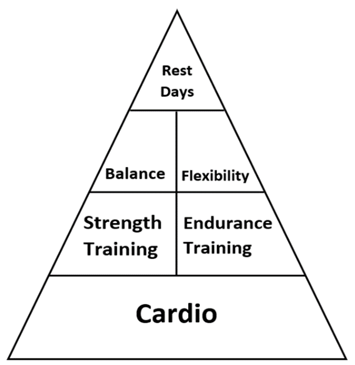
As Fitness Centers and gyms have opened back up after closing from the Pandemic, it’s a good time to restart our exercise routines and habits. There are many components to meet the healthy recommendation for exercise in older adults such as cardio, strength or endurance training, balance, and flexibility. To break it down, I decided to use the same model as the food pyramid and create an exercise version of that pyramid. Over the years the food pyramid has been used to simplify what quantities to eat of what food groups. Larger quantities shown in the bottom of the pyramid and the least quantities at the top. In this model the same concept applies. All components of exercise are necessary for a healthy exercise lifestyle but the exercise components on the bottom should be done more than the quantities at the top.

Cardio can be done almost every day. It is the base foundation of a healthy exercise lifestyle. It should be done about 5 days a week for at least 30 minutes (or 150 minutes/week). It helps strengthen one of the most important organs of the body: the heart. Luckily, it can be done simply through walking, biking or using cardio machines in your local Fitness Center.

Either strength training or endurance should be done at least twice a week on nonconsecutive days and includes exercises for each large muscle group of upper and lower body. Not as often as cardio but still a firm foundation to the body and upkeeping muscle strength to perform ADLs (Activities of Daily Living) like cooking, cleaning, getting around the house or other buildings and activities that make life more enjoyable like hobbies or recreational activities.

Balance and Flexibility are recommended about 2-3 times a week for maybe 10-15 minutes. This becomes important the older we get as every day injuries become more apparent due to falling and low flexibility. It is also important for seniors because as the risk of falling increases and the chances of getting severe injuries from falls increases.

The top category is Rest Days. Everyone’s rest time looks different but is important to everyone’s body. Rest can include proper sleep, rest from exercise or rest from an injury. With rest from sleep, it helps us function better during the day, being more aware of our surroundings to help reduce falls and giving us energy to exercise. Rest from exercise helps prevent an injury from over training. There is a reason strength training isn’t recommended every day. To repair the muscles from training they need to rest to recover and build back up. Rest from injury is another important element to a healthy active life. By not allowing injuries to properly recover decreases the benefits from future exercise as you aren’t able to do it 100% and it may cause more injury due to overcompensation.

There’s no one category of exercise that can help fulfill the benefits of all the different categories combined throughout the week. When residents come to ask what specific exercise, they can do to better their life, is like asking what food they can eat to decrease weight quickly. It must all be combined to reap the benefits of a healthy lifestyle. There are a lot of elements to a healthy lifestyle but broken down into a week, picking just one or two a day will help fulfill a weeks’ worth of exercise recommendation. Just like we need to eat and supply our bodies with energy every day we need to utilize the energy created in the most optimal way to better our life for the next day, week or month.

New call-to-action

Topics: active aging physical activity exercise and aging

The Power of Music During Exercise

GettyImages-1029347386If music is good for the mind, and exercise is good for the body why not combine the two at the same time?

Since I can remember, music has been a part of exercise, either playing in the background or exercising to the beat of the music. At the school gym there would be rock and roll playing while exercising on the machines. When running or walking outside I would find songs I can use the tempo of to keep a consistent pace. In group exercise class they would play upbeat motivational music to keep us moving and to help not focus on how hard we are breathing. During Yoga class, they play soft, meditation music to help calm our minds and relax into the poses and stretches we are trying to perform.

Many forms of exercise combined with different forms of music can help bring further benefit to the workout. By listening to preferred music, it can leave a positive effect on the brain and help associate what might be seen as a difficult workout more pleasurable. The exercise will be linked to the feeling of listening to a favorite song or favorite genre. With calming music during a cooldown or slower paced class like Yoga, music can bring our mind into a state of peace and relaxation.

Another benefit seen is music can keep the mind occupied while the body is working. When working out alone in a Fitness Center or at home, some people find it boring, especially having to wait during rest times before the next set or exercise. By incorporating music, the rest time becomes less tedious and more fun! Stretching the muscles at the end of a workout also takes time and patience to sit in a pose for 30 seconds up to a minute. With music that can become time to catch up on music you have been wanting to listen to or even podcasts or book audios if music is not an interest.

With today’s technology there are various methods to listen to music. There are many kinds of headphones to wear that can go over the ears or in the ears that are both corded or wireless connecting to a phone. Speakers used at home or TV channels that play almost any genre 24/7. There are even hearing aids that can wirelessly connect to a phone.

If music is not your jam that is okay too. For some, the silence during exercise can feel therapeutic. It might be the only time in the day or week that is a quiet time to reflect or not have to think about anything other than moving the body.

It is important to get exercise into the weekly routine and it can be hard to find ways to make exercise more enjoyable. It can be a mind game to be convinced to go out for a walk during a cold day or go to a fitness class that is early in the morning. There have been many strategies discovered to help beginners into the habit of routine exercise. Music might just be the missing element to a more pleasant and active lifestyle.

Topics: exercise senior fitness music workout music