
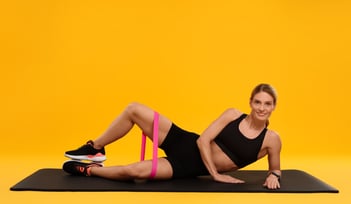
 Lifting heavy is great for meeting your goals of increasing muscle size and tone, but it can also lead to joint pain and muscle imbalances. Adding a Loop Band to your training plan can help strengthen your stabilizing muscles in your hips and glutes. The band can also lessen strain on your knees and hips.
A loop band is like a resistance band, except it is a continuous loop. This allows you to put it around your ankles or knees without having to hold it with your hands. The shape of this allows for different uses than a traditional resistance band. The loop band comes in different lengths and thicknesses, allowing you to pick the correct band for your specific needs. Loop bands generate constant tension while doing the exercise, and the harder you pull against the band, the more it pulls back on you. The properties of these bands activate your stabilizer muscles during the full range of motion.
These stabilizer muscles are key in keeping your joints aligned and moving the way they are intended. Bands are a great change-up from heavy load workouts and are a fantastic supplement to protect your joints. Adding loop bands to your routine is a great way to add strength to your lower body, protect your joints, and engage your stabilizer muscles in your hips.
Lateral Band Walks
15-20 steps each direction x2
-
Place the band around your ankles or just above your knees. Drop into a mini-squat position and take steady steps to the side, keeping the band stretched tight. This exercise builds outer hip strength and teaches your knees to track straight.
Standing Glute Kickbacks
15-20 total x2
-
Keep the band around your ankles. Hold onto a stable surface for balance, tighten your core, and press one leg straight back behind you without arching your back. This isolates and sculpts your glutes.
Fire Hydrants
15-20 total x2
-
Start on your hands and knees with the band positioned just above your knees. Keeping your knee bent at a 90-degree angle, lift your leg out to the side. This movement locks in hip stability and targets hard-to-reach muscles.
Clam Shells
12-15 per side x2
-
Lie on your side with your knees bent and the band just above your knees. Keeping your feet glued together, open your top knee toward the ceiling like a clamshell to strengthen your deep hip rotators.
Glute Bridges
20-25 total x2
-
Place the band around your thighs just above your knees. Lie flat on your back with your knees bent and feet on the floor. Lift your hips toward the ceiling while gently pressing your knees outward against the band to maximize glute activation.
Glute Bridge w/ alt Leg Raise
12-15 / leg total x2
-
Hold your body at the top of a standard glute bridge, then lift one foot a few inches off the floor while keeping your hips completely level. Alternate legs to challenge your core and hip stability.
 Being in the fitness field, we hear excuse after excuse as to why people skip exercising. It’s not that we aren’t interested in your life and stressors, but we do not want you to feel obligated to explain yourself. Life happens, as any understanding person should know, and sometimes we just can’t do it all.