
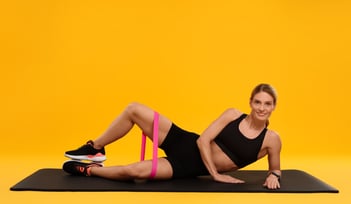
 Lifting heavy is great for meeting your goals of increasing muscle size and tone, but it can also lead to joint pain and muscle imbalances. Adding a Loop Band to your training plan can help strengthen your stabilizing muscles in your hips and glutes. The band can also lessen strain on your knees and hips.
A loop band is like a resistance band, except it is a continuous loop. This allows you to put it around your ankles or knees without having to hold it with your hands. The shape of this allows for different uses than a traditional resistance band. The loop band comes in different lengths and thicknesses, allowing you to pick the correct band for your specific needs. Loop bands generate constant tension while doing the exercise, and the harder you pull against the band, the more it pulls back on you. The properties of these bands activate your stabilizer muscles during the full range of motion.
These stabilizer muscles are key in keeping your joints aligned and moving the way they are intended. Bands are a great change-up from heavy load workouts and are a fantastic supplement to protect your joints. Adding loop bands to your routine is a great way to add strength to your lower body, protect your joints, and engage your stabilizer muscles in your hips.
Lateral Band Walks
15-20 steps each direction x2
-
Place the band around your ankles or just above your knees. Drop into a mini-squat position and take steady steps to the side, keeping the band stretched tight. This exercise builds outer hip strength and teaches your knees to track straight.
Standing Glute Kickbacks
15-20 total x2
-
Keep the band around your ankles. Hold onto a stable surface for balance, tighten your core, and press one leg straight back behind you without arching your back. This isolates and sculpts your glutes.
Fire Hydrants
15-20 total x2
-
Start on your hands and knees with the band positioned just above your knees. Keeping your knee bent at a 90-degree angle, lift your leg out to the side. This movement locks in hip stability and targets hard-to-reach muscles.
Clam Shells
12-15 per side x2
-
Lie on your side with your knees bent and the band just above your knees. Keeping your feet glued together, open your top knee toward the ceiling like a clamshell to strengthen your deep hip rotators.
Glute Bridges
20-25 total x2
-
Place the band around your thighs just above your knees. Lie flat on your back with your knees bent and feet on the floor. Lift your hips toward the ceiling while gently pressing your knees outward against the band to maximize glute activation.
Glute Bridge w/ alt Leg Raise
12-15 / leg total x2
-
Hold your body at the top of a standard glute bridge, then lift one foot a few inches off the floor while keeping your hips completely level. Alternate legs to challenge your core and hip stability.
 When life gets busy, it can be hard to always get into a proper workout space or gym to get a workout in, especially with tight-packed schedules, family life, or work stress, and finding the right time. This can make it easy for regular fitness habits to be placed on pause, with it being difficult to go back. Being active does not have to be a time-consuming commitment or create unnecessary stress. Doing small workouts that are 30 minutes or less can be effective and keep you active without requiring large amounts of time. Exercise does not have to be done in a gym setting; even short amounts of physical activity have been found to improve sleep, elevate energy levels, and reduce stress.
.png?width=299&height=251&name=WC%20Social%20Graphics%20(2).png) As adults, sometimes thinking about having to carve out time to exercise feels heavy and even unmotivating. We get stuck in our routines, and daily movement becomes another chore to cross off the list. What if you could reframe that mindset? What if movement could feel like adult recess—a time to be creative, play, explore, and try new things? This doesn’t have to be an everyday occurrence. Bringing fun into your routine even a few times a week can help exercise feel more meaningful and sustainable. Here are some ways to make that shift:
As adults, sometimes thinking about having to carve out time to exercise feels heavy and even unmotivating. We get stuck in our routines, and daily movement becomes another chore to cross off the list. What if you could reframe that mindset? What if movement could feel like adult recess—a time to be creative, play, explore, and try new things? This doesn’t have to be an everyday occurrence. Bringing fun into your routine even a few times a week can help exercise feel more meaningful and sustainable. Here are some ways to make that shift:.jpg?width=393&name=GettyImages-470296838%20(1).jpg) Caffeine functions as a stimulant, which means you will experience an increased heart rate, more blood flow to your body, and more oxygen to your muscles when you consume it. Here are
Caffeine functions as a stimulant, which means you will experience an increased heart rate, more blood flow to your body, and more oxygen to your muscles when you consume it. Here are 
.jpg?width=464&name=Traveling-Airport%20GettyImages-495963242%20(1).jpg)

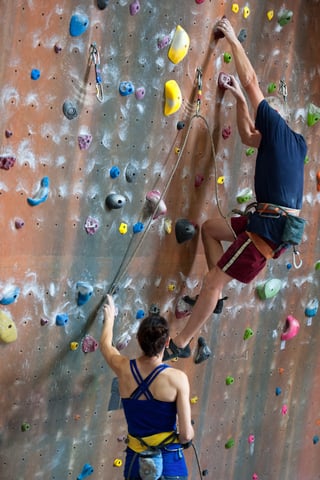 Someone recently asked me, “What is your favorite workout?” I thought about my answer for a little bit. I do like to run, and I usually run about three days a week, but is that my favorite workout? No, my favorite workout is always when I’m trying new exercises or activities!