
Corporate Fitness and Active Aging

Employee Health: Is Organic Food Really Better?

Rhubarb resized 600In the health craze of organic and all-natural food, it's easy to get confused and not know where to turn. What exactly is organic? How do I know I can trust what’s on the label? Is organic really better for me? These questions and more have been up for debate for years and will continue to be for many to come.


What Is Organic Food?

Organic food is defined by the USDA to be grown “free of synthetic substances; contain no antibiotics and hormones; has not been irradiated or fertilized with sewage sludge; was raised without the use of most conventional pesticides; and contains no genetically modified ingredients.”

Many true organic farmers feel we have a long way to go beyond this definition. For example, animals must be given access to the outdoors, but for how long and under what conditions isn’t defined. Furthermore, most farmers who practice sustainable farming and are organic in spirit operate on such a small scale that they can’t afford the expensive requirements to be certified organic by the USDA.

Organic Does Not Necessarily Mean Local, Healthy, or Inexpensive

A common misconception is that organic means local. This is not true. You could buy organic salmon from Chile, but what kind of carbon footprint are you leaving behind?

Organic also does not mean healthy. In this article in the New York Times, Marion Nestle, a professor at New York University’s department of nutrition, food studies and public health, says, “Organic junk food is still junk food.”

Additionally, organic foods are more expensive. If you can manage spending a few extra dollars, WebMD recommends buying the following organic foods:

  • Dairy products
  • Beef
  • Spinach
  • Apples
  • Berries
  • Peaches
  • Pears
  • Green beans
  • peas
  • squash

Another option is frozen organic produce.

Organic Does Have Some Health Benefits

In a recent study conducted by the Journal of Agricultural and Food Chemistry and highlighted in this article, organic tomatoes were found to have nearly twice the levels of quercetin and kaempferol as regular tomatoes. These two compounds are known as flavonoids, which have been linked to a reduced rate of heart disease.

So far, more money has been spent on marketing organic foods than on the nutritional benefits of organic products. So more it will take more time, money, and research before people understand the full effects of organic foods.

Are You Confused Yet?

So if you are now more confused than ever, it's quite understandable. Starting your own garden is a great option, but it's not always feasible. The point here is to buy local, buy seasonal, and if possible buy organic local products. Being an informed consumer is always a good thing.

If you have access to corporate wellness programs or an onsite fitness center, don’t hesitate to ask your worksite wellness staff for more information on organic food and other health topics.

Topics: corporate wellness nutrition

Three Tips for Keeping Worksite Wellness Resolutions

Your employees will soon be considering their New Year’s resolutions. And there’s a good chance that, shortly after they make those resolutions, they’ll break them. The failure rate for resolutions—75% or higher, according to a Wall Street Journal report—is startling.

Don’t miss this chance to maximize the New Year as an avenue toward a healthy workforce. Consider the following tips to create easy healthful opportunities for your employees:

  1. Create ways for your employees to exercise. Bring group exercise onsite. Make a worksite fitness center out of unused meeting-room space. Establish a walking program or partner with a local commercial fitness center for reduced-rate memberships.
  2. Get creative with signage at work. Fran Melmed of Free Range Communications offers an intriguing blog on ways to maximize signage at work to help employees make better choices. My favorite idea is to post notes on vending machines indicating how many minutes on a treadmill will be required to burn off the choice candy bar that costs more than $1.describe the image
  3. Encourage healthy food choices. Speaking of food, a study just came out indicating that when people use cash to pay for food, they tend to make healthier choices. Apparently those in the study were less likely to make impulse buys on unhealthy foods when they were paying cash for their groceries. Perhaps worksite cafeterias should initiate a cash-only payment policy.

How will your worksite leverage New Year’s resolutions to create a healthier workforce?

Topics: exercise at work corporate fitness program healthy workforce nutrition worksite wellness

The Role of Workplace Wellness in Nutrition

Helping Employees choose the right supplementsThe other day one of my wellness center members approached me about my advice regarding vitamins and supplements. She had been feeling extremely tired and fatigued while at work and wanted to know if there was something she could be taking to combat her exhaustion. I was happy to see that she was increasing her activity in hopes of boosting her energy, but she said she was still feeling tired even after a 15-minute walk on the treadmill.

Supplements Can Fill In Your Employee's Nutritional Gaps

Vitamin and mineral supplements are a great backup plan for when our diets may be lacking in all the recommended fruits and vegetables we need. If you’re like me, this is pretty frequent. Although they are not necessary, it is nice to be able to fill in the nutritional gaps in our day-to-day diet choices with a supplement. This is especially true if you are on a diet that eliminates an entire food group or you are a vegetarian.

Encourage Employees to Speak to a Professional When Taking Supplements

It is best to speak to your doctor or a registered dietician when considering supplements so he or she can tell you which supplements are best. Additionally, if you are already taking a daily supplement, you should notify you doctor or pharmacist because some can interfere with your medications.

Supplements Aren't Always the Answer

Sometimes exhaustion can be caused by something as simple as eating too few calories or too much sugar. After a few questions with my member, we discovered that she was drinking almost no water (or any other liquid, for that matter). I encouraged her to keep a regular sleep/wake cycle, to continue exercising and I recommended that she increase her water intake.

Follow up with this member found her feeling much better! I was thrilled. She said her exercise routine is getting easier and she has drastically increased her H20.

A Health Professional Could Benefit Your Company

Many people suffer from fatique and exhaustion. Your company could benefit from offering employees the resources of a degreed exercise specialist or registered dietician as part of its employee health benefits. An exercise professional can assess your employees needs and, if necessary, refer them to a registered dietician who can not only assess one’s diet and make recommendations for improvement, he or she can suggest appropriate supplements if necessary.

Topics: corporate wellness nutrition

Employee Weight Loss and Nutrition: Quality Over Quantity?

employee food choicesIf you’re skeptical like me, you may have questioned some of the weight-loss methods you’ve seen in the media. After all, any diet that requires you to substitute steak for fruit salad is sure to be a hit, but how healthy can that really be?
Amidst all the confusion a simple question remains: When looking to lose weight, what matters more? What you eat, or how much you eat? Here are some thoughts to share with overweight employees looking to make a change.

Tell Employees to Burn More Calories Than They Consume

Dr. David Katz, director of the Yale Griffin Prevention Research Center, seems to offer a simple answer. Dr. Katz points out that “The fundamental truth is that energy balance, calories in versus calories used, determines weight.” Put even more simply, the only way to lose weight is to burn off more calories than you consume. There’s really no mystery about calorie balance.

But it’s not quite that easy. How do you know if you should cut out carbs, pump up the protein, or follow any one of the many other suggestions out there along with eating less?

Nutritionist Mark Haub, an associate professor of nutrition at Kansas State University, answered these very questions with a unique experiment. For one month he ate a high-fat, high-sugar, low-nutrient diet consisting of Twinkies, Nutter Butters, canned or frozen vegetables, a protein supplement, steak, and milk averaging 1,800 calories per day. Believe it or not, he lost weight--15 pounds in the one-month experiment.

Tell Employees to Eat Less but Also Eat Healthy

So how much you eat has more bearing than what you eat--unless you actually want to lose weight in a healthy way.

The major problem with any diet is that you go on it, but eventually must come off of it. So unless you plan to maintain a diet the rest of your life, the odds are you will regain the weight you lost once you resume your normal eating habits.

The long and the short of it? Eat just enough of foods that are good for you and get on with the rest of your day!

Topics: employee health overweight employees nutrition

Decrease Salt. One Important Way to Improve Employee Health

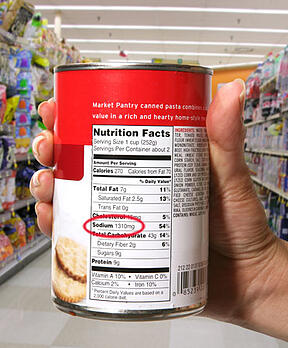
Employee Health Through Reading Food LabelsIn a tough economy, many of your employees are making logical changes in spending habits. They are probably taking fewer vacations, eliminating extras from TV subscription packages, and using e-mail more frequently to save a few cents on a stamp. One thing we hope your employees aren't sacrificing, however, is good, healthy and lightly processed food.

Encourage Employee Health by Providing Health Tips that Teach Them What to Look for on Food Labels

Buying cheap food is tempting when you're at the grocery store, but convenience and processed foods aren't necessarily the way to go. Purchasing frozen meals and other processed food items can drastically increase sodium intake.

Even items you wouldn't think contain salt might be sneaking it in to employee diets. For example, on a recent trip to the store for a bag of frozen peas, I glanced at the back of the package only to find the words “peas, water, and salt” listed as the ingredients. I looked at a few other brands and, wouldn't you know, several had salt listed, as well. I did find one that had only peas and water, a small success that can add up!

Let Your Employees Know the Effects of Excess Sodium

You're probably thinking “what's the big deal? It's just a little salt,” but Americans consume entirely too much sodium. What does excess sodium intake result in? Hypertension! And what does hypertension mean? An increased risk for heart attack and stroke.

Most of your employees don't even realize that hypertension is a preventable illness, meaning that people can actually do something to prevent hypertension from sneaking up on them. The best form of prevention is to monitor your daily salt intake by glancing at the nutrition label on the foods you eat and keeping a tally of what you're putting into your body. According to the American Heart Association, we should be consuming 1,500mg of sodium or less per day.

In addition to keeping track of how much sodium you consume, incorporating physical activity into your daily routine can reduce your risk of developing hypertension. 

Make Employees Aware of the Risks

Think about this: With all the hype about healthy eating and increasing exercise, shouldn't more companies be tuning into what they can do for their employees in order to reduce the cost of healthcare? Encourage employees to take the next step to a healthy lifestyle and start paying better attention to what they are putting into their bodies. Once people make this a habit, the performance they'll get out of their bodies will be even better!

Topics: employee health nutrition disease prevention control healthcare costs