
 Register your community for our FREE educational event and get your residents pumping for Parkinson's Disease as we raise awareness!

Over 15 years ago, I remember sitting down at the computer in my senior living client’s fitness center and Googling, “exercises for Parkinson’s disease”. I had a new resident move-in with Parkinson’s and though I’m a certified and degreed exercise physiologist, I wanted to make sure I understood how to support her needs. Her name was Carolyn and I still remember her smile.
I now work at the operational level for NIFS supporting dozens of senior living clients and team members across the country. I benefit from a bird’s eye view of hearing successes and challenges impacting our communities and what residents want in their fitness center. I was continuing to hear requests from clients and staff for Parkinson’s resources. Our clients wanting a quality, yet manageable program that stands up to their brand promise in helping residents live well, and from our staff feeling like there were missed opportunities to better engage these residents.
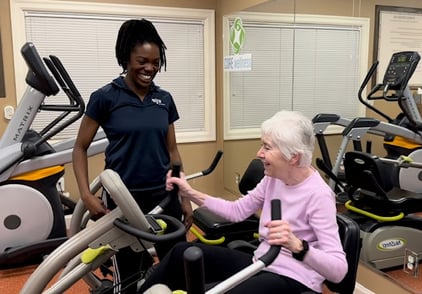
Our staff are degreed fitness professionals, but those credentials don’t tell the full story of who they are as people. They are intuitive and gifted in relationship building with their members. They shared stories of individuals with Parkinson’s trying an existing balance class and noticing they weren’t coming back. They shared stories of what they were witnessing in the emotional needs of these residents who can also experience fatigue and depression.
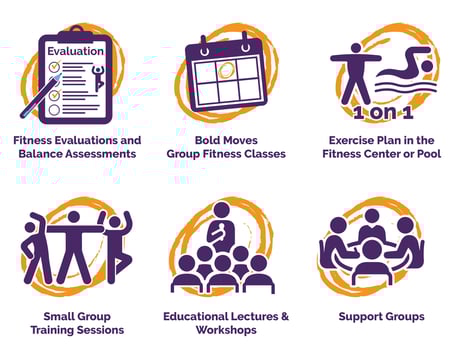
As a prospective or current resident with a diagnosis speaks to our clients or staff, we want them to feel confidently met with exercise options that they know are designed for their needs. This is where Bold Moves was born. We spent over a year researching, completing specialized certifications, and meeting with our team to learn not only how to better support the exercise needs of those with Parkinson’s, but in a way that we know is manageable in a senior living fitness environment. We know the equipment, spaces, personnel, and resources commonly in place and created safe and empowering programming with Bold Moves that our staff could apply across different client settings.
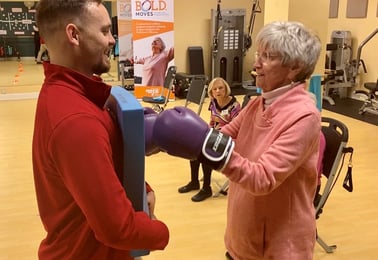
Many think they have classes and one-on-one services that residents with Parkinson’s can participate in already. This was our line of thinking too. But after implementing Bold Moves, the level of engagement by residents with Parkinson’s skyrocketed. In the first two months of the program, we saw a 96% increase in group fitness participation by these individuals having a dedicated class on the calendar uniquely designed for their training needs. We have also seen a 100%+ increase in completion of our one-on-one exercise prescription service. These residents are regularly engaging in their community’s fitness centers more and it’s amazing to see how far we’ve come since the days of that simple Google search looking for resources!
We were so pumped by these outcomes; we wanted to celebrate and share resources to help more communities support their residents. On World Parkinson’s Day, we are going BIG with Pump it for Parkinson’s. During this nationwide event on Tuesday, April 11, senior living providers will come together, utilize complimentary programming materials to host their NuStep step-a-thon, and receive expert resources from NIFS to continue supporting their residents with Parkinson’s. Don’t have a NuStep in your community? That’s OK. We can find opportunities utilizing the equipment you do have. It is estimated that one million people are living in the US with Parkinson’s and our goal is to come together and complete at least one million steps on the NuStep as we Pump it for Parkinson’s. In addition to the great Parkinson’s resources including instructional videos for your fitness staff and education from NIFS Registered Dietitian, your community will also have an opportunity to win a free NuStep T6 Cross Trainer in thanks to our partnership with NuStep! We are thankful for our industry partners with NuStep, ICAA and Wellzesta who are helping us spread the word about this event so more communities can join us. For more information and to register your community, visit our Pump it for Parkinson’s page here.

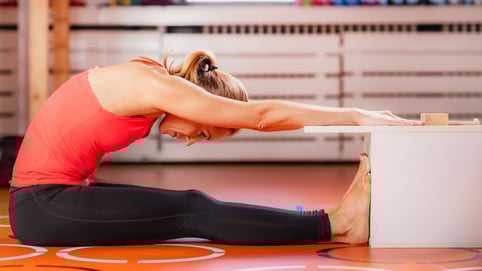 One of the best things you can do when it comes to tracking your progress with fitness is a fitness assessment. A fitness assessment is roughly a 30–60-minute consultation with a health and fitness professional where you are tested on the 5 components of fitness: body composition, muscular strength, muscular endurance, flexibility, and cardiovascular endurance. Some assessments may also test for balance, mobility, or more sports performance biased like power and agility. But for the sake of this article, we are focusing on the 5 components of fitness.
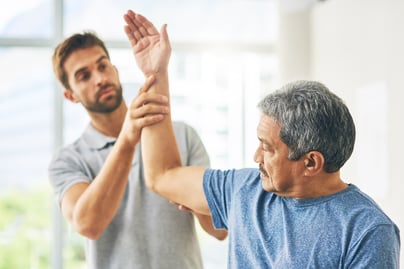 Arthritis is an increasingly common condition that refers to 100 different types of diseases, affects all age groups and affects 1 in 4 adults, equating to 80 million people in the United States. The most common form seen is osteoarthritis or degenerative joint d
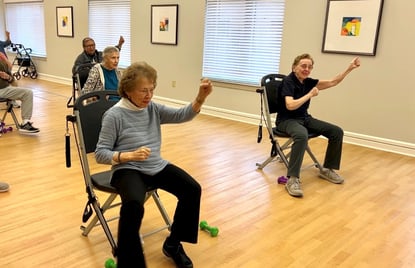 This is a great question because it is a priority for our clients (and for us) to make sure
 Staffing shortages
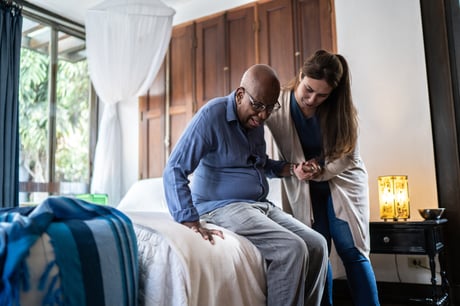 In sharing the many benefits of living in a senior living community with seniors, I often receive the response “I want to live in my home as long as I possibly can”. Making sure you are active and healthy can improve your life to maintain that desire to remain in your home. Below are 4 tips to consider before making that important decision.
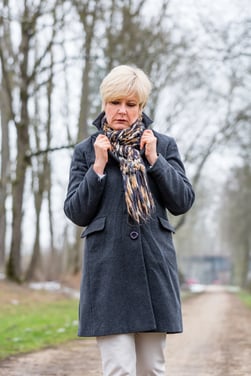 After the excitement of holiday parties and festivities slows down, we sometimes find ourselves in a funk. Life can seem a bit slow, minimal sunlight and weather keeps us cooped up inside, and we feel a bit sluggish. Get rid of winter blues with these tips to warm the soul.