
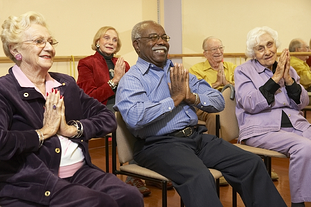
 What are some challenges in developing group fitness classes for active older adults? One of the hardest things for me is that there is a wide variety in exercise knowledge and ability. For example, you might have someone who has never exercised a day in their life sitting next to someone who has been exercising in a gym for decades. Or, you may have someone in their middle 60s next to someone who is 85 with two knee replacements.
To overcome these challenges, make sure that you give both a progressive and regressive option for each exercise that you are teaching. Allow the individuals to experiment with what works for them. Each individual will choose how hard they want to make the exercise, but it is the instructor’s responsibility to ensure they are able to complete the exercise in a safe and effective manner for their varying ability levels. Encourage the participants to try new exercises, but also let people know that it’s okay to progress slowly over several weeks or months. The most important aspect is that they keep moving and have fun while feeling accomplished at an appropriate intensity level for their needs.
Use Visual and Verbal Cues
Each individual will learn in his or her own way. Make sure that you not only show them a visual demonstration but also use verbal cueing that may help them. At this age, some of your residents may not see well and others may not hear well. Pick out key words or moves that may help them remember from one class to the next.
Explain Why They Are Doing the Exercise
It is also important to educate senior fitness participants on why they are doing different exercises. Describe the reason for the exercise, the muscle group being worked, and how it should feel while performing the exercise. This can help participants become more in tune with their bodies and may help prevent injury if they develop improved body awareness.
For example when cueing upright rows, explain to the participants that the exercise can help improve their posture because it engages the muscles of the upper back and backside of their shoulders. As you cue them through the movements, explain how to engage the shoulder blades so they can specifically feel and identify where the muscles should be working if the exercise is being done correctly. For someone who does not have a good visual of the exercise being demonstrated, it may provide reassurance that they are performing the exercise correctly if your verbal cueing is matching up with what they are feeling.
 The New Year often provides the fitness industry with a boom of customers hoping to hold true to their resolutions. Many of those resolutions often pertain to unrealistic weight-loss goals.
 A leader is someone who can guide, direct, or show the way. Wouldn’t you hope the leaders in your life have had experience or are educated on whatever matter they are pressing?
 Most people would agree that regular exercise is part of a healthy lifestyle, but how much of an impact does physical activity really have on one’s health and well-being?
 “Exercise is boring…,” “I don’t have the time…,” or “I don’t know where to start” are words many have used as excuses at some point or another in regard to a fitness routine or lifestyle change. With the emergence of
  This article
 Investing time and other resources in an employee wellness program as part of your broader business strategy can certainly lower increasing health care costs. Active, healthy employees also have fewer hospital admissions and disability claims. Providing employees with a corporate fitness center, group exercise classes as well as health seminars to teach them how to choose better health motivates workers to take advantage of what is available. You may also find that you reap other unintended but positive outcomes like improved employee morale through increased networking opportunities between upper management and employees.
 Motivation Ideas
 To fully understand the relationships that exist between positive emotions and food choices, researchers dissected the traits that classify personalities as happy and/or hopeful. They found that those with hopeful personality traits focus mainly on the future, while people with happy personalities tend to beam from past achievements. In looking toward the future, hopeful people choose more health-conscious snacks, and also exhibit greater levels of self-control than their happy, prideful counterparts who are simply “living for the moment.”