
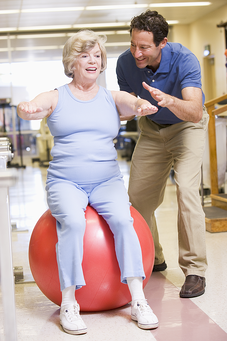
 Balance: simple right? I regularly work with a senior population that tells me, “My balance is lost” or “I don’t have balance.” They are under the impression that you either have balance or you don’t.
But your body’s ability to maintain your balance is much more complicated than having it or not. Your body, or your brain, processes multiple sensory and motor inputs to help you stay upright.
The Sensory Systems Involved in Balance
Your brain relies on sensory information from three systems in your body:
- Vestibular (inner ear): This is a system of channels in your inner ear that allows your brain to know your body’s position, relative to gravity, while your head is moving.
- Vision: This system works with your vestibular system to keep objects in focus by relaying to the brain the location of external objects in relation to the body.
- Somatosensory (nerves): This system is used by the brain to know the position of your center of gravity in relation to your base of support.
Your brain uses the information from your sensory systems with your motor system, which works to control the actions of your muscles to detect changes in your body position with respect to your base.
Balance Diminishes with Age
Your balance naturally diminishes as you age because your brain’s ability to receive and integrate sensory information is reduced. This is why it is important to start training your balance before you begin to notice any problems.
If the function of one or more of your sensory systems declines (say you lose your vision or develop a neurological condition that would affect your somatosensory system), your brain will have to rely more heavily on the other properly functioning systems for information.
What Can I Do to Work on My Balance?
Regular exercise (cardiovascular, strength, and flexibility training) is great for areas of your balance. But if you're looking to focus more specifically on balance, the easiest way is by adding or making simple changes to your current exercise program. You can do this by changing your base of support to make it smaller. The smaller or narrower your base is, the more difficult it is to maintain your balance.
Try adding in exercise stances such as these:
- A narrow stance: Stand with your feet together, side by side.
- Semi-tandem stance: Stand with your feet together and then take a big step forward with one foot. Your feet should be hip width apart with a step length between them.
- Tandem stance: Stand with your feet together and then place one foot in front of the other so you are standing heel to toe.
Other ways to manipulate your base of support include using a BOSU stability trainer, standing on a foam pad or wobble board, or using an exercise ball. These will provide an unstable surface for your base of support, making it even harder. You can also add exercises to the balance stances listed above to challenge your sensory inputs by turning your head side to side or looking up and down, closing your eyes, or reaching with one or both arms.
Balance isn’t just one thing; your brain is constantly working to process all kinds of information to keep you on your feet. But just like any other type of exercise, with some practice you can certainly do a lot to improve your balance.
 With the start of a new year, work schedules can begin to take over. Try as we might to make a permanent slot in our schedules for gym time, appointments and assignments seem to pop up at the most inconvenient times. Often times people tend to believe that just because they don’t have a whole hour to spend at the gym, there is no use in working out at all.
 For you: Take care of yourself as well as your family by carving out time to exercise and limiting sedentary behavior, which will give you energy to keep up with your family’s busy schedule. It’s always important to lead by example.
 It’s a new year, and you may be eager to start fresh with new resolutions, goals, and a lengthy to-do list. Give yourself the best chance to achieve success by providing your body with the energy it needs!
 There is no doubt about it: water is good for you in several different ways. How much water is needed per day varies from person to person. Water needs vary because you need to take into account how active someone is or how much they sweat on average. So if the staff at your onsite corporate fitness center makes you sweat a lot during class, you need to be sure to drink plenty of water throughout the day to stay hydrated. Not drinking enough water can decrease your energy level and cause health issues.
 Another new year is here, and with that come high fitness expectations that your corporate wellness participants place upon themselves. When members come to us with New Year’s resolutions, our first step is to teach them how to set appropriate goals that will lead to success. Once you have the general picture of what your clients are hoping to achieve as well as why it’s important to them, you can help in fine-tuning their goals.
 There are many reasons for seeking the help of a personal trainer. Corporate health and fitness specialists can introduce you to an exercise routine, help you break through a rut, or give you the extra boosts of knowledge, motivation, and accountability that you need to achieve the next level in your fitness. But how do you pick a trainer?
 When cuts are being made in your organization, there may be even more pressure to earn your keep and ensure you’re meeting work demands. Finding time to exercise during the day may not be an option when workloads are mounting.
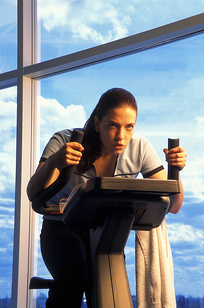 Working at a corporate fitness center, I get a lot of questions on how to shrink the waistline. You may or may not have heard the phrase “you can’t spot reduce,” and it’s true. For example, performing stomach exercises alone won’t decrease the size of your stomach. There are, however, a couple of different things to consider when wanting to lose weight or tone up.
 Recently, the cost of health care has risen to over $2.5 trillion and is projected to increase, on average, 6.1 percent per year until 2019. These costs have also risen for employers who pay for their employees' health plans.