 We’re a staffing organization – we provide well-credentialed and passionate fitness professionals to manage senior living fitness centers and corporate fitness programs for our clients. To say we know a thing or two about interviewing could be, perhaps, an understatement. Over the last 30+ years, we’ve hired hundreds of staff to fill a variety of fitness-focused positions for a diverse clientele. We have definitely made some mistakes and we’ve lived to tell about it.
Hiring is a risky proposition and that’s true for any type of opening you have. But when you’re talking about the health of your residents or your employees, are you prepared to make a hiring decision for a job about which you don’t understand the credentials or the essential duties? Think of it this way: You don’t repair your own brakes on your car – that’s what your mechanic is for. Why would you tackle hiring for a position about which you know nothing? In the end, you may want to consider pulling in an organization like ours that does this for a living.
But, if you insist on pressing on hiring your own staff, check out our top three lessons learned on interviewing health-focused staff.
Tip #1: Do a double check on candidate credentials.
Our business IS fitness, so we’ve seen the credentials that are out there. But if you’re an executive director trying to staff your senior living community fitness center or a human resources executive hiring for your employee wellness program, how do you know that the credentials presented by a candidate are worth their salt? Don’t take this the wrong way, but…you don’t.
The sad truth about fitness is that personal trainer certifications are a dime a dozen. You, dear reader, regardless of your educational background, could jump online tonight and within a short window of time, be a “certified personal trainer”. So be careful about credentials for the candidates you interview because they don’t always carry a lot of weight. And until the industry initiates registration or licensure, hiring a fitness instructor who carries a certification that isn’t backed up with a health-related bachelor’s degree is a very employer-beware circumstance.
In order to win an interview with NIFS for a fitness-focused opening, candidates are required to have at least a bachelor’s degree in a health-related field. This doesn’t guarantee the right fit for the opening, but it’s a good start.
To that end, there are probably dozens of degree program names for an allied health type of career: Kinesiology, Exercise Science, Health Promotion, Wellness, etc. If you’re unsure about if/how the candidate’s degree fits for your opening, you can ask some pointed questions about the coursework the candidate completed, or direct your questions to the types of tasks she performed at another job.
Case in point: We had a candidate with a health promotion degree apply for a fitness center manager opening. When we dug a little deeper into her background in anatomy and physiology, she responded by saying something like, “You know, the ankle bone is connected to the shin bone, and the shin bone is connected to the knee bone.” I’m not kidding. You can’t make this stuff up.
Tip #2: Require the candidate to demonstrate his/her skills.
In a field where your candidate will be working with employees or residents to help individuals improve their health, where there is a lot of hands-on work, it will be imperative that they can demonstrate competency in those practical skills.
You can ask a candidate about his/her experience teaching group fitness and he/she may impress you by describing the formats she’s taught, the audiences to whom she’s taught, and the feedback she’s received from her participants. But until you see her in action, his/her words are useless. Trust me, I know enough about group exercise that I could talk a really good game about my style, my music, the ways I modify classes for participants, and the anecdotes participants in my classes have shared with me. And it would all be just words. All you have to do is ask me to teach a five-minute core class and you would quickly see that teaching group exercise is not on my list of gifts.
Your interview process should include testing on practical skills required for the job. When candidates interview for a fitness career with NIFS, we require them to prove their competency throughout the interview by offering the following (and more):
- Provide us with copies of print materials they’ve created for other employment or in school.
- Evaluate a health history questionnaire according to the American College of Sports Medicine (ACSM) risk stratification.
- Write and administer an exercise program from a case study.
- Teach a short group exercise class.
- Provide a brief wellness presentation.
Case in point: Each time we offer an interview to a candidate, they receive an email outlining everything they should be expected to do during the interview. One time, we had a candidate accept the offer for an interview after receiving a detailed email from us. When we got to the part in the interview where we require the candidate to evaluate a health history questionnaire according to ACSM risk stratification, she looked at me and asked, “What’s risk stratification?” Seriously.
Tip #3: Make sure the candidate understands your audience.
It’s worth noting that today’s graduates are moving through health-related degree programs that require an internship to graduate. But there was a day (trust me, I would know about this) when degree programs did not require an internship. Use the required internship that your candidate has under her belt to dig a little deeper into that individual’s preferred clientele.
Let’s face it, not everyone can hack it in a corporate wellness program based in a manufacturing setting. Some candidates would be bored in a white-collar office environment, and still, others have no business working with an active aging audience in a senior living setting. Ask some probing questions to find out whether your candidate really fits your environment and your audience.
Case in point: On more occasions than I care to admit, I have interviewed candidates who, when talking about the demographic with whom they prefer to work, have indicated that they’re OK working with “older adults”. When I press what they mean by “older adult”, they say something like, “You know, adults over maybe age 40 or 45.” And I used all the energy I have left not to laugh out loud.
What to do about your candidate opening.
If this blog has you wondering about your ability to hire your own fitness professional, particularly in a time when so many businesses are struggling to fill open positions with qualified staff, download our quick read on how NIFS finds and retains top professionals in the industry.

 We already know that exercise is a key contributor to a healthy lifestyle overall, but for those with Parkinson’s Disease (PD) this is no exception! In fact, exercise is extremely critical for people with PD, and
 This month our corporate members are encouraged to pick a goal of 5,000 or 10,000 steps per day to kick of July’s Prove YOU Move Fitness Challenge. Some people cringe at the thought of 10,000 steps per day, but it isn’t just intentional exercise. Have you ever considered how many steps you actually take in a given day? How often are you moving throughout the office or your house? You might actually surprise yourself. Most phones have a Health App, or you can add a step tracker to your smart phone. If you keep your phone on your body throughout the day, it will calculate your movement and track your steps. As you start digging into your phone, don’t get down on yourself when you discover how little you possibly move, remember your phone must be on your body throughout the day to get the best estimate.
 Name:
Name:  Every Sunday, I make a cup of coffee and head outside. I often just sit and listen to the sounds all around me. I take it all in. Even now I can feel the sun on my face, sense the gentle breeze, the sound and feel of the chair as it gently rocks back and forth. It is so easy for me to close my eyes and bring myself right back to that moment whenever I need to. There is something about being outdoors that feels so important to me. Every experience in my life seems more fulfilling while I am doing it outdoors.
 Name:
Name: .jpg?width=422&name=GettyImages-674714126%20(1).jpg) I recently had a resident from one of our client sites in Illinois contact me wanting to know which senior living communities in greater-Indianapolis NIFS was partnered with as she would soon be relocating to be closer to her daughter. She wanted to refine her search to communities where NIFS was similarly providing a robust health and fitness program to what she had come to experience in her current community. She had done some exploring on her own and quickly recognized that communities simply having an onsite fitness center with some weekly
I recently had a resident from one of our client sites in Illinois contact me wanting to know which senior living communities in greater-Indianapolis NIFS was partnered with as she would soon be relocating to be closer to her daughter. She wanted to refine her search to communities where NIFS was similarly providing a robust health and fitness program to what she had come to experience in her current community. She had done some exploring on her own and quickly recognized that communities simply having an onsite fitness center with some weekly 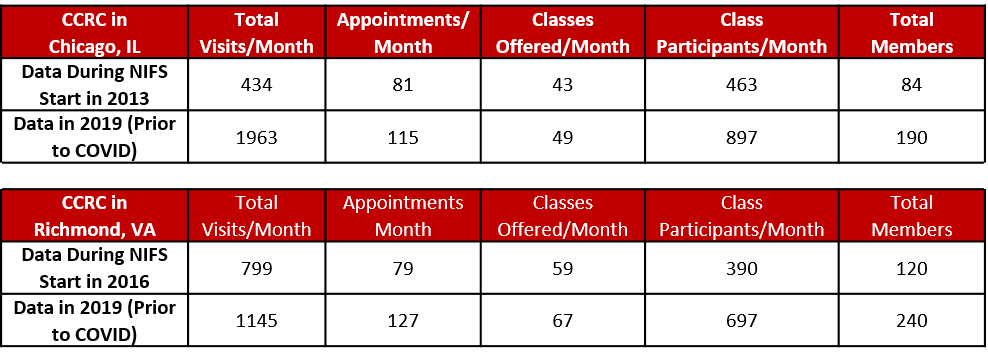

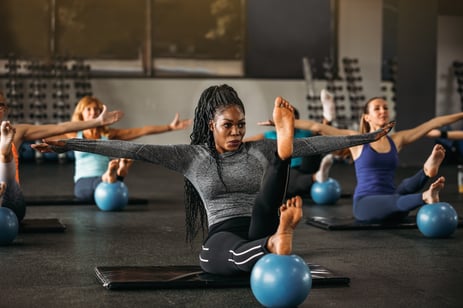 When waking up early in the morning, it can be extremely difficult to make it through a morning workout by yourself or perhaps you may not push yourself as hard through the last round of squats as you power through alone. There is a quite a bit that can be said about exercising in a group and how it births motivation.
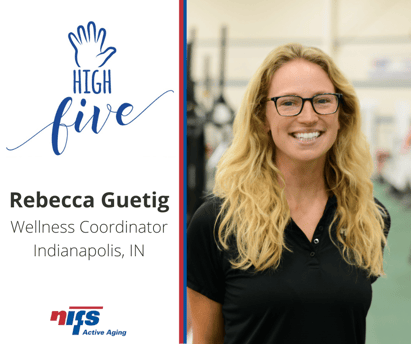 We say it with pride quite regularly, our amazing staff in
  How can older adults improve their wellbeing, grow closer to others, and enhance the community in which they live? Practicing vocational wellness is a great way to accomplish these important feats.