 Have you ever stood up after sitting at your desk for a while and felt stiff? Or maybe you noticed your shoulders feel tight after a workout, or your hips don’t quite lie like they used to?
If so, you’re not alone.
Most people think mobility is important for athletes or yoga enthusiasts, but the truth is mobility plays an important role in every move we make- from exercising to carrying the groceries inside to simply getting out of bed in the morning.
The good news? It doesn’t take hours of stretching to improve your mobility, and the benefits can make a noticeable difference in how you feel inside and outside of the gym.
What Is Mobility?
Mobility is your body’s ability to move its joint through the whole range of motion with control. While flexibility does play a factor, mobility utilizes strength, stability, coordination, and joint health.
Think of mobility as your body’s ability to move better and comfortably, not just move farther.
Whether you’re reaching overhead to grab something off the shelf, squatting down to pick up a box, or exercising in NIFS wonderful fitness center, good mobility helps those movements feel smoother and more efficient.
Why Mobility Matters for Strength Training
Have you ever struggled to squat lower or press a weight overhead comfortably? Limited mobility may be part of that reason.
When joints can’t move properly, the body often compensates by changing movement patterns. Over time, this can make exercises feel more difficult and place extra stress on muscles and joints.
Improving mobility can help you:
- Move with better technique
- Perform exercises through an increased range of motion
- Improve balance and stability
- Generate more strength throughout each movement
- Feel more confident during your workouts
- Moving better often leads to training better.
Mobility Helps Cardio, Too
Mobility isn’t just for lifting weights.
Whether you enjoy walking, pickleball, running, cycling, hiking or kayaking, healthy joint movement allows your body to move more efficiently. Better mobility can improve posture, encourage a smoother movement, activate the core, and reduce the stiffness that often develops during repetitive movement.
When your body moves efficiently, exercise tends to feel more comfortable- and that’s something everyone can appreciate.
The Benefits Don’t Stop at the Gym
One of the greatest benefits of improving mobility is how much it impacts everyday life.
Simple activities become easier when your body moves well:
- Standing up from your chair
- Climbing stairs
- Carrying groceries
- Reaching overhead
- Playing with children or grandchildren
- Gardening or yard work
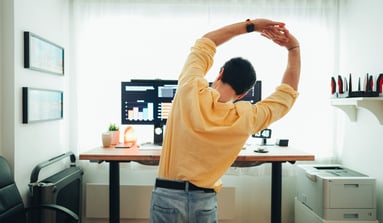
If you spend much of your workday sitting, your hips, shoulders, legs and back can gradually become stiff. Taking a few minutes each day to move these areas can help reduce discomfort and improve how you feel throughout the day.
Simple Ways to Improve Mobility
The best part about mobility is that you don’t need a long workout to see benefits.
Here are a few easy ways to get started:
- Spend 5-10 minutes warming up before exercise with dynamic movements
- Get up and move every hour during the workday
- Include a few mobility exercises after your workouts
- Strength train through a comfortable, full range of motion with good form
- Stay consistent- even a few minutes a day can make a difference
Like most healthy habits, small efforts consistently add up over time.
Try These Mobility Exercises
Not sure where to begin? A quick search for any of these movements will show you exactly how to do them- so don’t worry if you’re unfamiliar with the names. These movements are great for most people:
- Worlds Greatest Stretch
- Cat-Cow Stretch
- Hip Flexor Stretches (pigeon stretch and lunge stretch)
- Thoracic Spine Rotations
- Ankle Circles/Dorsiflexion and Calf Stretches
- Deep Squat Hold (using support if needed)
- Shoulder Pass Throughs with a resistance band, towel or even a PVC pipe
Perform each movement slowly, control deep breaths, and focus on quality rather than forcing a deeper stretch.
Keep Moving Well
Mobility is one of the most overlooked components of fitness and even life, yet it influences nearly every movement you make inside and outside the gym. Better mobility can improve your strength, make cardio feel more efficient, and help everyday activities become easier and more comfortable.
You don’t have to be an athlete to benefit. Investing a few minutes each day in improving your mobility can lead to better movement, greater confidence, and healthier, more active lifestyle.
Remember, moving more isn’t just about exercise- it’s about making everyday life feel better.
 Have you ever set a big goal - such as exercising regularly, drinking 64oz of water daily, getting 8 hours of sleep daily, or improving your overall health? Only to find yourself struggling to stay consistent after a few days? This is very common. Many individuals start with good intentions for all their goals but often get overwhelmed by them, making it difficult to stay focused on achieving those goals. Although this can be very frustrating to accept sometimes, we must start with small commitments to create habits to crush long-term commitments. Most of the most successful actions start with short-term commitments. Instead of looking at these long-term goals maybe you simplify them to start by exercising 3 days a week instead of everyday, start by drinking at least 32 oz of water a day, aim for 6-8 hours of sleep every night, or maybe you focus on fitness before you focus on weight goals to improve your overall health. By focusing on manageable actions over a set period of time to become more consistent and build confidence, eventually these short-term commitments will become easier and more natural.
 Short-term commitments are a great place to start when trying to make changes. They feel more manageable and less stressed. Committing to a change/goal for a week or month will feel less stressful and less intimidating than looking at the entire long-term goal. Short-term commitments will also decrease the possible mental barriers you may face. It also removes the excuses, and it's easier to convince yourself to take smaller steps rather than a long process drawn out every day. Short term commitments also help in shifting focus instead of looking at the total distance you are just focusing on the small term goals that are directly in front of you. These short-term victories increase self-confidence and create positive momentum that encourages long-lasting efforts.