
.png?width=340&height=340&name=Untitled%20design%20(38).png) Most of us know that exercise is good for our physical health. It helps us stay strong, improve our balance, support our heart health, and continue doing the things we enjoy. But movement is not only good for the body. It can also have a meaningful impact on how we feel.
Most of us know that exercise is good for our physical health. It helps us stay strong, improve our balance, support our heart health, and continue doing the things we enjoy. But movement is not only good for the body. It can also have a meaningful impact on how we feel.
Think about the last time you took a walk, stretched after sitting for a while, or joined a fitness class. There is a good chance you felt a little more energized, relaxed, or positive afterward. Movement can be a simple way to support both our physical and emotional well-being. The best part is that you don’t need to complete a long or difficult workout to feel the benefits.
Movement can be as simple as walking down the hallway, stretching in your chair, working in the garden, or moving along to a favorite song. It might mean joining a group fitness class, completing a few balance exercises, or taking five minutes to move before starting your day. It all counts!
Movement can also give us a much-needed break from whatever may be weighing on our minds. When we are worried, frustrated, tired, or simply having a tough day, a little activity can help us reset. It gives us something positive to focus on and may help us return to the rest of our day feeling a little clearer or more refreshed.
-1.png?width=376&height=219&name=Untitled%20design%20(37)-1.png)
There is also something powerful about the feeling of accomplishment that comes from moving our bodies. Maybe you walked a little farther than you expected. Maybe you tried a new class. Maybe you completed ten minutes of activity on a day when you did not feel like doing anything at all. Those small wins matter.
Of course, exercise won't make every difficult feeling disappear, and that is not the goal. We all have days when we feel stressed, sad, frustrated, lonely, or unmotivated. Movement is simply one tool we can use to care for ourselves during those moments.
The key is finding an activity that feels enjoyable and realistic for you. Try to start with just five minutes and notice how you feel. You may feel calmer. You may have more energy. You may feel proud that you did something positive for yourself.
There is no perfect workout, and every day does not have to look the same. Some days you may feel ready for a full class or a longer walk. Other days, a few gentle stretches may be enough.
The next time you need a little boost, remember that movement may be one of the simplest places to start. Move in a way that feels good, make it something you enjoy, and give yourself credit for every step.
Register your senior living community for our nationwide Move Your Mood event on Tuesday, October 6. Join us as we strive for 5,000 senior workouts in a single day!
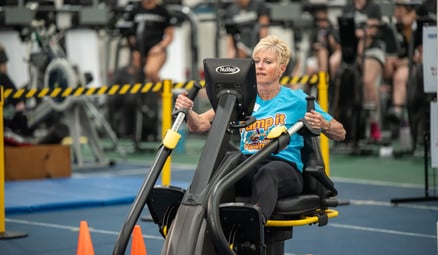

 It’s raining, it was a rough day, my sports team lost, my dog looked at me funny. There are so many easy excuses to go home, relax on the couch, crack open a cold pint of ice cream, and take the stress away with a favorite show. Seems like the way to deal with the challenges in life, right? Maybe for an occasional day, but there’s something better out there! Believe it or not, strength training is a great way to build resilience to life’s problems.
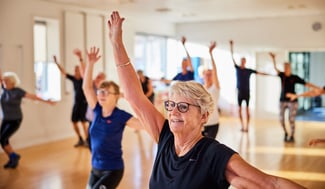 When I think about my fitness journey, I realize the biggest changes weren't just physical. Of course, getting stronger, improving my balance, and feeling healthier were all exciting milestones. But what truly kept me coming back wasn't the workout itself; it was the people. I knew others were expecting to see me, and before long, I was looking forward to seeing them too.
 “I don’t always enjoy exercising, but I love when it’s done!” This statement is one of the most popular comments I hear in the fitness center, whether it’s a class or someone exercising on their own. Then, they often explain that it’s not just that they’re glad the exercise is over, but it’s about how they feel afterwards. They relieve stress, they feel accomplished, and even feel energized afterwards. We know there are many physical benefits to exercise, such as improving heart health, controlling blood pressure, improving bone, joint, and muscle health, and reducing the risk of type 2 diabetes. Recently, it is also becoming more common to hear about the mental and emotional benefits of exercise.
 The question is no longer, “Do we have a fitness center?” The stronger question is, “Are we using the fitness center to its full potential as part of our mental wellness ecosystem?”