
Summer is the best time for outdoor activities and fuel in the form of food is needed to support the fun. However, food safety can be a challenge in the summer, with more individuals becoming sick with a foodborne illness than any other season, as the warmer weather is an optimal environment for bacteria to grow. Between leaving food out in the hot summer sun to accidental cross contamination on the grill - here’s how to ensure you’re keeping your food safe this summer.
 Wash your hands.
- As always, you should wash your hands before preparing or eating any food, however, it is especially important to do so before and immediately after handling raw meat.
- If soap and water are not available, use an alcohol based hand sanitizer with at least 60% alcohol.
- Cook food at the proper temperature.
- Utilize a clean thermometer to measure the temperature, rather than guessing based on how it looks. Fresh fish, pork and beef steaks/chops should be cooked to a minimum internal temperature of 145°F, while eggs and ground beef (hamburgers) to 160°F, and 165°F for chicken and turkey.
- Utilize a clean thermometer to measure the temperature, rather than guessing based on how it looks. Fresh fish, pork and beef steaks/chops should be cooked to a minimum internal temperature of 145°F, while eggs and ground beef (hamburgers) to 160°F, and 165°F for chicken and turkey.
- Store food properly.
- Not only is it important to cook food to the proper temperature, but food must be kept at the appropriate temperature to avoid bacterial growth that can result in unsafe food.
- Cold foods should be kept below 40°F and discarded if they reach a temperature of 70°F or higher.
- Hot foods should be kept above 135°F, refrigerated within 1 hour if it’s >90°F outside, and discarded if they have been sitting below 135°F for >4 hours.
- Don’t cross contaminate.
- Marinate foods in the refrigerator, rather than on the counter or outside. Dispose of marinades and sauces that have come in contact with raw meat/raw meat juices immediately.
- Keep raw food separate from cooked food.
- Use a separate utensil/serving dish for handling raw and cooked meats and other foods.

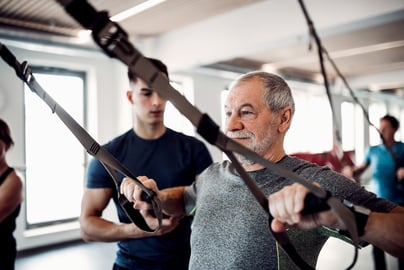 Working with a senior population, the most commonly asked question I probably get is “How can I strengthen my legs/back/core.. etc?” As exercise professionals, we already know how as far as the exercise prescription goes, but with seniors, modality often becomes a challenge. Our clients typically have a whole range of physical issues to deal with including joint pain, balance issues, and overall weakness so the traditional sit-to-stand exercises aren’t always applicable. That’s where the TRX suspension training system comes into play.
  We all know that exercise is great for your health, but too often we think of improving our health as being able to move better, losing weight, having more energy, decreasing stress, or even improving our heart health, which are all great benefits don’t get me wrong! However, did you know that exercise can improve our memory and cognitive function as well? If not, you aren’t alone. The benefits that exercise can give our brain often tend to be overlooked.
 Working on one’s strength, agility, form, balance and flexibility are all so very important. Building/working on one’s strength helps prevent or lessen an injury. Using weights helps to strengthen the muscles. That being said, working the same muscles every day is not beneficial. Muscles need time to recover. Doing repetitive movements breaks the muscles down and causes wear and tear which leads to injury.
  As we age there are many different changes that start to happen to our brain such as shrinkage, vasculature and cognition. With age, the brain shrinks and changes occur at all levels, from chemicals to morphology. Stroke, lesions, and dementia are all more common as people get older, as is memory impairment. Fortunately there are quite a few things we can do to help prevent or slow the process of some of those changes from happening. Regular exercise, a good diet, and low to moderate alcohol consumption, all of which minimize cardiovascular risk, appear to help the aging brain, as does increasing cognitive exertion in the form of schooling, games or meaningful activities. Physical and mental health may be the best defense against the effects of aging on the brain.
 Did you know federal law doesn’t require the potency, purity, efficacy, or safety of dietary supplements to be proven prior to being put on the market? In fact, most dietary supplements are already being sold before the Food and Drug Administration’s safety monitoring role begins. This means you could be taking a supplement that doesn’t even contain what is listed on the label, or that contains significantly different amounts than it claims to contain. This is concerning, as data from the National Health and Nutrition Examination Survey conducted in 2017-2018 revealed that close to 60% of U.S. adults reported taking a dietary supplement within the last 30 days, and this percentage is predicted to be on the rise.
 Barre, a fitness regimen, has recently gained a lot of popularity over the years. This low-impact exercise does not require any fancy, expensive equipment and people of all ages can do it. It is a workout that combines elements of Ballet, Pilates, and Yoga. It focuses on low-impact, high repetition, and small isometric movements to strengthen and tone your body.
 Progress is defined as “forward or onward movement toward a destination,” and in fitness it is usually related to a specific fitness goal. Evaluating progress allows you to track your accomplishments or if you are not making the progress you hoped for, it can help determine what you can do better to reach your goal. Whether you are trying to lose weight, gain muscle mass, improve your 5k time, etc. tracking and evaluating your progress throughout your fitness journey is beneficial.
 There is a very clear, well understood relationship between food and physical health, but
 Mental health has been a growing topic of conversation over the last few years, and for good reason. The first step of mental health awareness is being comfortable enough to talk about it. This topic is no longer taboo, and people are learning to prioritize their mental health. According to the CDC, “Mental health includes our emotional, psychological, and social well-being. It affects how we think, feel, and act.” Mental illness effects millions of people in the U.S. each year. It’s important to measure how common mental illness is so that we can recognize that no one is alone in their battles.