
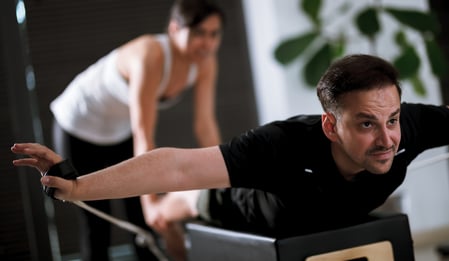
 Did you know your everyday posture could have an effect on your overall health and wellness? Your posture is a makeup of your musculoskeletal system at work to maintain proper positioning throughout the body regardless of it you are in motion or static. While posture tends to be an automatic position that most of us do not notice, being hyperaware of your posture throughout the day could lead to positive overall changes in spinal health, balance, movement efficiency, breathing, focus, mental health, and maximizing your muscle gains during exercise.
First, let’s debunk the idea of maintaining a “perfect” posture. Everyone’s body is different, so, in turn, everyone’s posture is different. Putting too much stress on yourself to fit the mold of a “perfect” posture could be more detrimental than beneficial. This is due to the mental stress and muscle tightness that accompanies the overall anxieties of maintaining a “perfect” posture. Instead of trying to perfect our posture, let’s try to make our posture healthy.
How do you know if you have poor posture? There are plenty of common body symptoms that could exist because of improper positioning of the body. Improper posture could lead to back pain, headaches, neck pain, shoulder pain, and be a hindrance on your flexibility, mobility, or balance. According to The Pelvic Girdle, a clinical textbook that discusses posture and biomechanics (including breathing mechanics), bad posture can also reduce your lung capacity by 30%, leading to feeling groggy, having lack of focus, or experiencing shortness of breath.
To maintain a healthy posture, make sure your head is always above your shoulders, shoulders always directly above the hips, maintain a neutral spine, keep your core muscles braced, and stabilize the lower body. To stabilize the lower body while standing, make sure to drive your weight more toward the midfoot or ball of your foot and keep the feet separated about shoulder width apart. Your weight should be equally distributed between both legs. To stabilize your lower body while sitting, make sure your feet lie flat on the floor with ankles apart and legs at a 90-degree angle. A good tip if you are unable to reach the floor from your chair is to utilize a footstool to maintain a proper 90-degree angle.
Incorporating small but effective mental and physical exercises everyday can lead to better posture overall. Arguably the most important muscle group associated with a health posture is your core muscles. Practice engaging your core intentionally throughout your day. How do you engage your core? The simplest way to put it is to imagine you are zipping up the fly on your tightest pair of jeans, so you must suck your belly button back to your spine and stand tall. That is the same sensation as engaging the core. Practice sucking your belly button to your spine while breathing steadily to trick your body into thinking this is your natural relaxed state. Making sure you have the proper footwear for your body’s gait is also highly important when it comes to proper posture. Runners Forum and Athletic Annex are two great examples of stores that will help you with gait analysis and fitting you with the proper shoes to aid your posture and comfortability throughout the day.
A disciplined diet and exercise routine will also lead to a positive change in posture due to the strengthening of the skeletal and muscular system. During exercise, the key muscle groups to hit to help improve your posture in order of importance are the core, upper back, shoulders, and glutes/hips. While strength training is important for those muscle groups in the posterior chain, having specified mobility/flexibility days incorporated into your workouts or everyday routine are vital for the release of tension of the muscle groups utilized in proper posture such as the chest, shoulders, back and hips. Working on your range of motion and loosening of the muscles will also help proper posture come more natural to you, which can take a lot of the mental stress of maintaining a healthy posture away.
A healthy posture is a lot more complex than just standing or sitting up straight. It is about creating a strong and stable foundation of the musculoskeletal system to support balance, breathing, boost confidence, improving focus, and efficiency of movements in everyday life. By making small, intentional changes now, you set yourself up for better movement, better workouts, and better overall health for years to come.

 We've all been there – motivated to get fit, only to find ourselves struggling to maintain a consistent workout routine. It's a common hurdle, and the good news is that there are solutions to overcome these challenges. Let's explore four key reasons you might find it hard to stick with your workouts and how to conquer them.
 THE BRAIN: the most important organ in our body, is often the most forgotten when we think of training. Why does the brain always seem to slip through the cracks? We can’t stop talking about BMI, body fat percentage, heart rate reserve, and all these other buzz words in the fitness industry. Now you’re probably thinking “but isn’t exercise good for the brain?” and you’d be right but there is more to it than that. We aren’t specifically targeting our brain, we’re focused on our muscles, our heart and the brain is just getting a splash of the love it deserves. That’s something I’d like to change! And we can do that in the gym and at home.
 “No Pan, No Gain”
.jpg?width=396&height=264&name=GettyImages-1354842116%20(1).jpg) The NIFS staff often find that employees will take time away from their desk to exercise, enjoy conversation that isn't work related, or simply decompress. Our staff are great at putting the FUN into Fitness which often results in laughter during classes, conversations and that sense of community in our client's onsite fitness centers.
The NIFS staff often find that employees will take time away from their desk to exercise, enjoy conversation that isn't work related, or simply decompress. Our staff are great at putting the FUN into Fitness which often results in laughter during classes, conversations and that sense of community in our client's onsite fitness centers.
 Exercising and having a healthy diet are key components to maintaining or even improving heart health. A heart healthy diet consists of food low in cholesterol, sodium, and high in fiber. Following the
  The impact of physical activity on mood has been researched over the last few decades. There has been speculation that an increase in physical activity can provide a substantial positive impact on one’s mood, but to what extent? Let’s dive into the known relationship between physical activity and mood, how much of an effect physical activity can have, and finally will provide a few brief explanations over the mechanisms of which physical activity increases mood!


 You’ve heard the saying, “it takes a village to raise a child”, right? The idea is that a child needs a whole village worth of support an influence, and education, and diversity to be raised into a healthy and vibrant member of society. If we look at individual wellbeing through a similar lens, I would say that it takes a team to help an individual be well.