
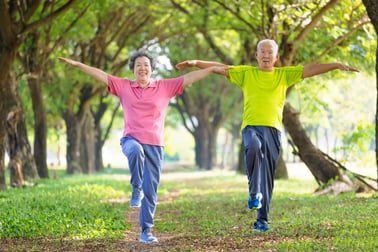
 According to the CDC, one in four older adults falls every year, which results in 14 million falls each year in the US. There are many contributing factors that lead to a fall; sometimes it might be out of the person’s control, but knowing this staggering fact, it would be wise for all older adults to invest time in their health and fitness. My favorite part of exercise is that almost all movement is considered exercise, so if you are intentional about movement every day, you will see maintenance or improvement in your fitness. What is even better, is if you challenge yourself, even in small ways, you will see even more improvement. Today, I would like you to consider challenging yourself for better balance.
- Walking! Holy smokes is walking underrated. And you might think to yourself “I walk all the time!” But are you really? Consider your typical 8 hour day, how many steps do you get? Adults 60 and older and in good physical health should aim for 6,000-8,000 steps/day. For someone with lower mobility, you should aim for 3,000-4,500 steps/day. Being upright and using your legs automatically engages you in balance exercise.
- Seated Exercise. Wait a minute… I just said that walking was one of the best ways to work on balance. Yes, it is, but walking isn’t easy for everyone, every day. You might have neuropathy, back pain, or experienced falls already, so walking feels a little scary… If this is the case, engaging in seated exercise 3-5 times/week like seated marches, leg lifts, toe taps, seated crunches, etc. improves muscle strength and endurance which are vital for balance.
- Specific Balance Exercises. Exercise that focus specifically on balance such as Tai Chi, Single Leg Stands, Heel to Toe Walking, Foam Balance Pad work, etc. challenge your balance so your body can practice reaction. Fitting in these types of exercises 2-3 times/week is ideal. Remember to start with exercises that are slightly challenging before progressing to more advanced work.
- Strength Exercises. Building muscle is so important when it comes to your overall health, but especially when it comes to stabilizing the body. Without strong muscles, your body has a harder time of standing up straight, handling obstacles, and reacting. Utilizing dumbbells, resistance bands, or selectorized strength equipment (like what you find in a gym), and water resistance in the pool are all ways to increase strength!
- Diet and hydration. Believe it or not but exercise isn’t the only piece to the puzzle when it comes to better balance. You must eat a balanced diet for level blood sugar, you must take proper medications to avoid interactions, and you must stay hydrated to avoid dizzy spells that accompany dehydration.
If you have a goal of improving your balance, start with these simple steps. Engaging in daily activities like these will help you pinpoint where you struggle when it comes to balance and other fitness and mobility areas. Take those cues and work on them one at a time. Improvements doesn’t happen overnight, so keep at it! I know you will do great!
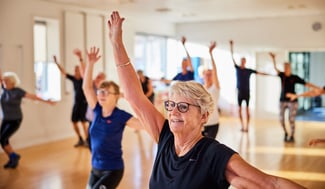 When I think about my fitness journey, I realize the biggest changes weren't just physical. Of course, getting stronger, improving my balance, and feeling healthier were all exciting milestones. But what truly kept me coming back wasn't the workout itself; it was the people. I knew others were expecting to see me, and before long, I was looking forward to seeing them too.
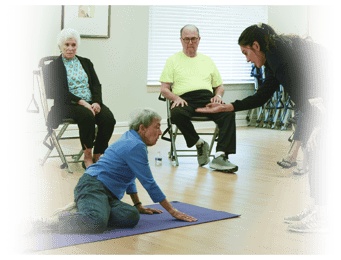 There are several health-related observances through the year and NIFS staff enjoy finding ways to use these to bring attention to important topics. One of those is Falls Prevention Week in September. As a fitness management provider for senior living communities, fall prevention is a hot topic so older adults can live vibrantly for as long as possible. But you might be wondering how can you make something that doesn’t sound so fun be engaging for residents? We have found that there is a love/hate relationship everyone has with any program labeled “Fall Prevention” because residents are certainly interested in learning about how to prevent falls but have a healthy fear of falling. What better way to face a fear than head on and in a practical way, right?
.jpg?width=477&height=318&name=GettyImages-1143018176%20(1).jpg) It isn’t a secret that as a person ages, there is an increased risk of falling. While there are a few different reasons this risk can increase, we will focus on what impacts a person’s ability to
It isn’t a secret that as a person ages, there is an increased risk of falling. While there are a few different reasons this risk can increase, we will focus on what impacts a person’s ability to 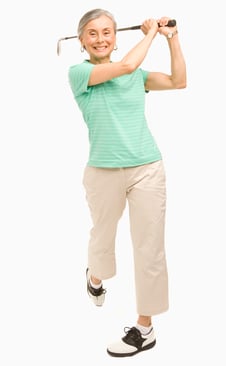 Most folks who have ever participated in balance training know that most exercises seem to involve only the legs. While it is important to focus on our lower extremities during our training, it is important to incorporate the use of our arms for more functional and effective training. Why? Because this will have more real-world applications! For example, practicing single leg stance is important for improving balance but most of us are not going to be in a situation where we must stand on one leg for an extended period of time. We will, however, be shifting our weight from one leg to another, swinging our arms like we do when walking, taking the stairs, dancing, or cleaning the house in real world daily activities.
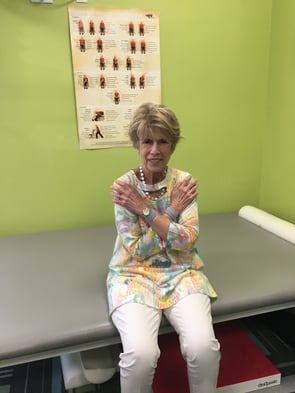 It is not uncommon that group fitness classes tend to be the bread and butter of a community’s fitness program. Classes provide so many benefits including guided exercises,
 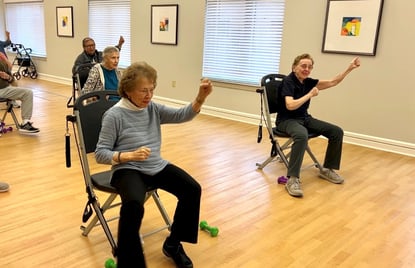 This is a great question because it is a priority for our clients (and for us) to make sure
.jpg?width=368&name=GettyImages-1047684930%20(1).jpg) When it comes to programming options in senior living, NIFS understands that communities strive to create a memorable experience for residents and their families all year long, which is why we are excited to bring clients the NIFS Legacy program. This is a simple one, but with a memorable result. We are inviting each resident to participate by handwriting answers to simple life questions and to have their photo taken to create a nostalgic piece that will then be transformed into a keepsake for the resident to share with their family.
When it comes to programming options in senior living, NIFS understands that communities strive to create a memorable experience for residents and their families all year long, which is why we are excited to bring clients the NIFS Legacy program. This is a simple one, but with a memorable result. We are inviting each resident to participate by handwriting answers to simple life questions and to have their photo taken to create a nostalgic piece that will then be transformed into a keepsake for the resident to share with their family.
.jpg?width=488&name=Active%20aging-seated%20stretches%20GettyImages-469952165%20(1).jpg)

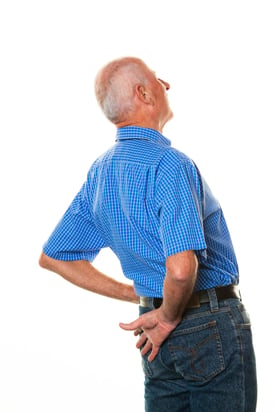 I am a firm believer in massage therapy because a little over a year ago, I woke up in agonizing lower-back pain that did not allow me to move. My first thought was maybe I should go see a chiropractor. I had been to one before, but was not the biggest fan because they cracked my back and sent me on my way after charging $65.